



By Zonex Systems, a Trolex Corporation company · Commercial HVAC zoning
Quick answer
VVT (variable volume and temperature) zones a single constant-volume or multi-speed rooftop or split system with modulating dampers, zone thermostats and a bypass. VAV (variable air volume) varies the fan speed and uses terminal boxes, usually on larger central systems. VRF (variable refrigerant flow) moves refrigerant, not air, to multiple indoor units. For most 5–25 ton jobs, VVT is the most direct way to add zones, usually at a lower first cost than VAV or VRF.
If you install or service light commercial equipment, you get asked some version of this question every week: the owner wants the conference room, the front office and the back storage area to stop fighting over one thermostat. Do you zone the rooftop unit, sell a VAV system, or go VRF?
Each one solves a different problem. This guide explains how VVT, VAV and VRF work, where each fits on 5–25 ton jobs, and what to check before you quote.
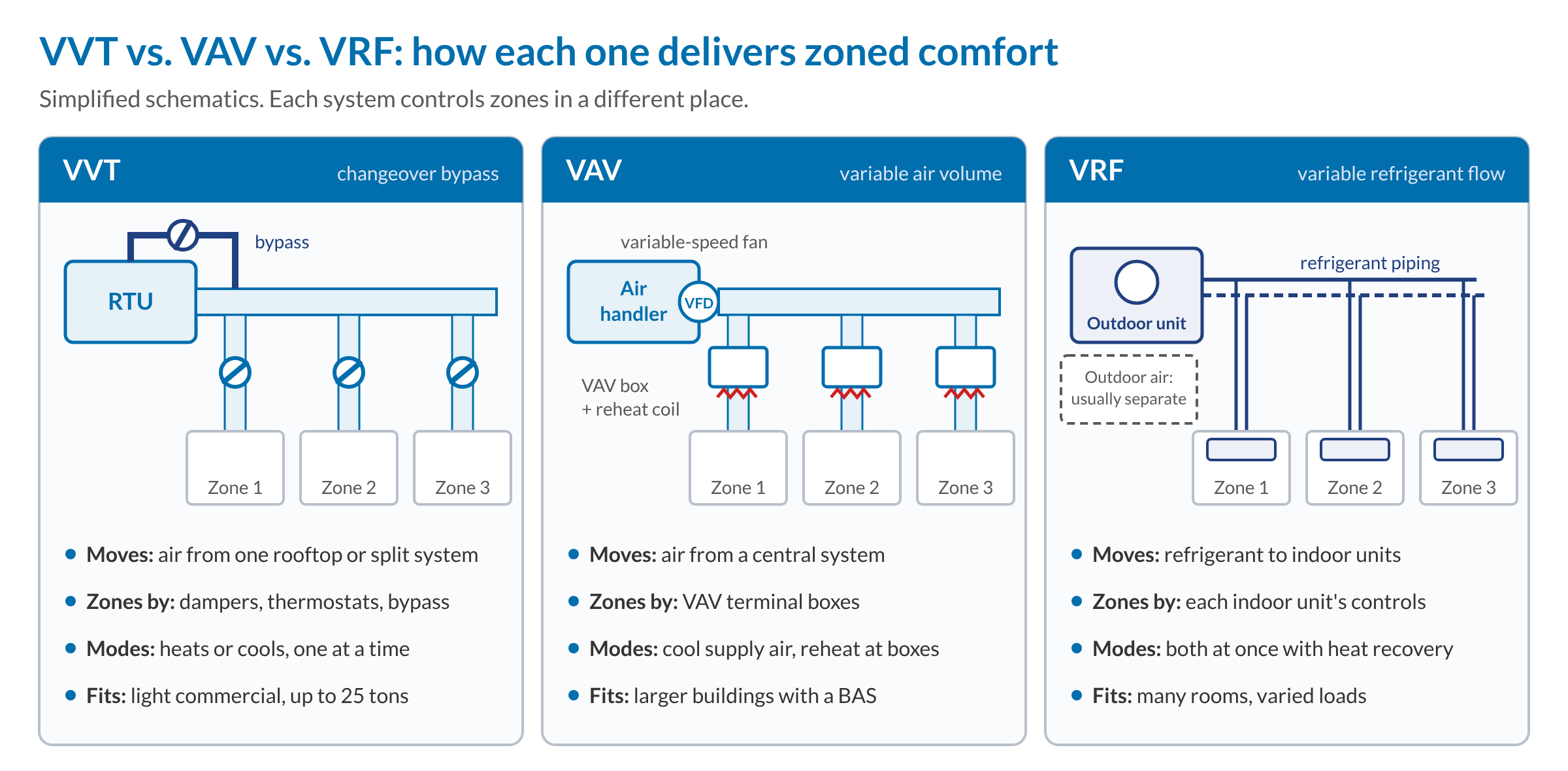
VVT vs. VAV vs. VRF at a glance
| VVT (changeover bypass) | VAV | VRF | |
|---|---|---|---|
| What moves the heating and cooling | Air from one RTU or split system | Air from a central air handler or large RTU | Refrigerant piped to indoor units |
| Typical fit | Light commercial, units up to 25 tons | Larger buildings with many zones and a building automation system | Buildings with many small spaces and very different loads |
| How zones are controlled | Modulating zone dampers, zone thermostats, bypass damper | VAV terminal boxes, variable-speed supply fan | Each indoor unit has its own control |
| Heat and cool at the same time? | One mode at a time; supplemental heat can cover exceptions | Yes, with reheat at the boxes | Yes, with heat-recovery models |
| Works with existing ductwork and RTUs? | Yes, often a retrofit | Usually needs new equipment and controls | Usually a replacement system |
| Relative first cost | Typically lower | Higher | Higher |
| Ventilation | Through the RTU’s outdoor air path | Through the air handler | Usually a separate outdoor air system |
What is a VVT system?
VVT stands for variable volume and temperature. A VVT system divides the space served by one constant-volume, multi-speed or variable-speed rooftop or split system into separate zones. Each zone has its own thermostat and a modulating damper, and a central control board decides whether the unit heats or cools. The industry also calls this changeover bypass VAV.
A VVT system has four main parts:
- Zone dampers installed in the duct to each zone. They modulate from 0 to 100% airflow, and come in round and rectangular styles. (Not sure which damper style to spec? See motorized vs. spring-loaded zoning dampers.)
- Zone thermostats that read the space temperature, open or close their damper, and tell the control board whether the zone needs heating or cooling.
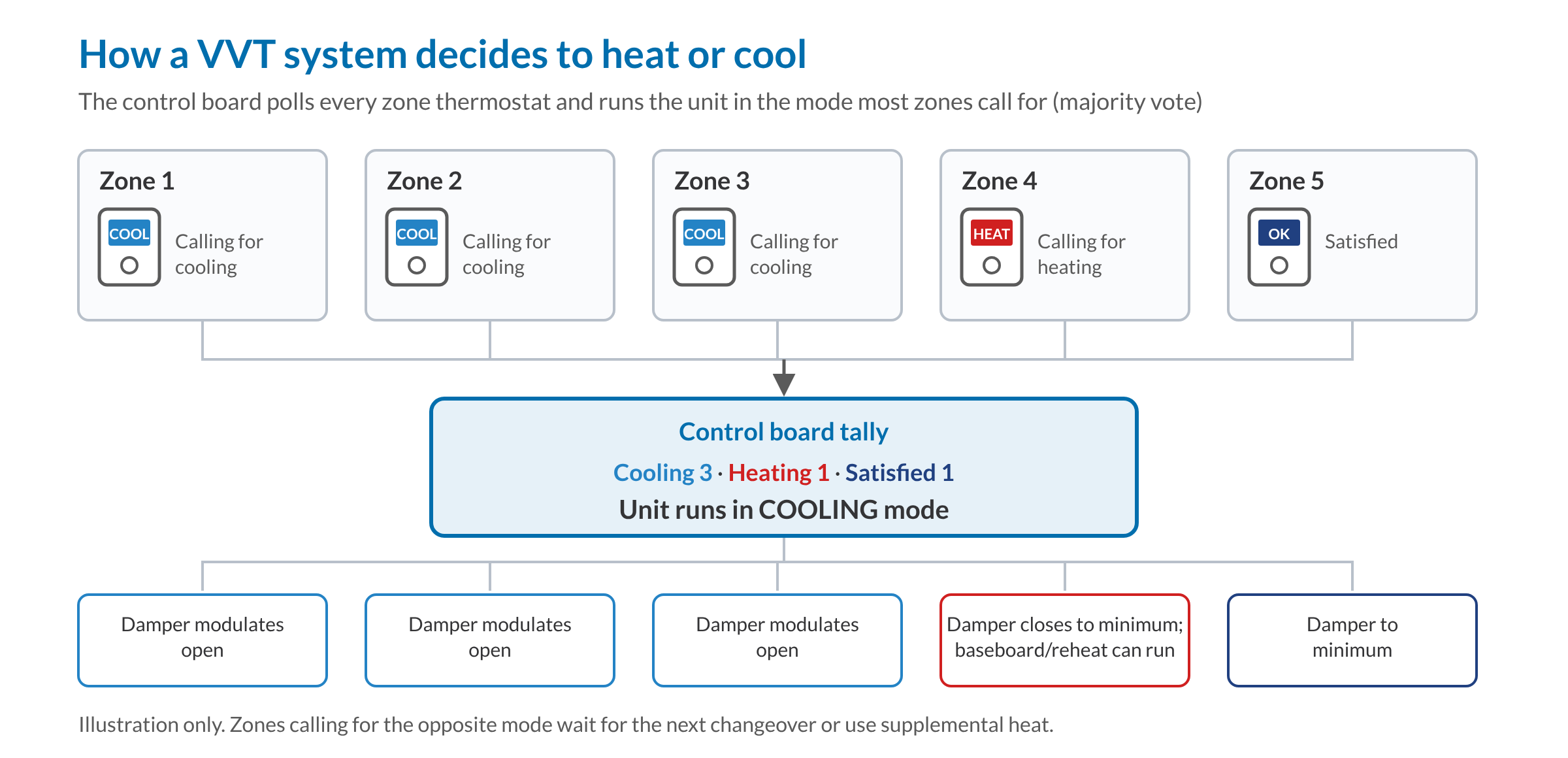
- A control board, the brain of the system. It polls the thermostats, and each zone “votes” for heating or cooling. The board runs the unit in whichever mode has the majority.
- A bypass damper that sends extra supply air back to the return when zone dampers close. This keeps air moving across the coil and holds supply static pressure in range, so you don’t get noisy registers.
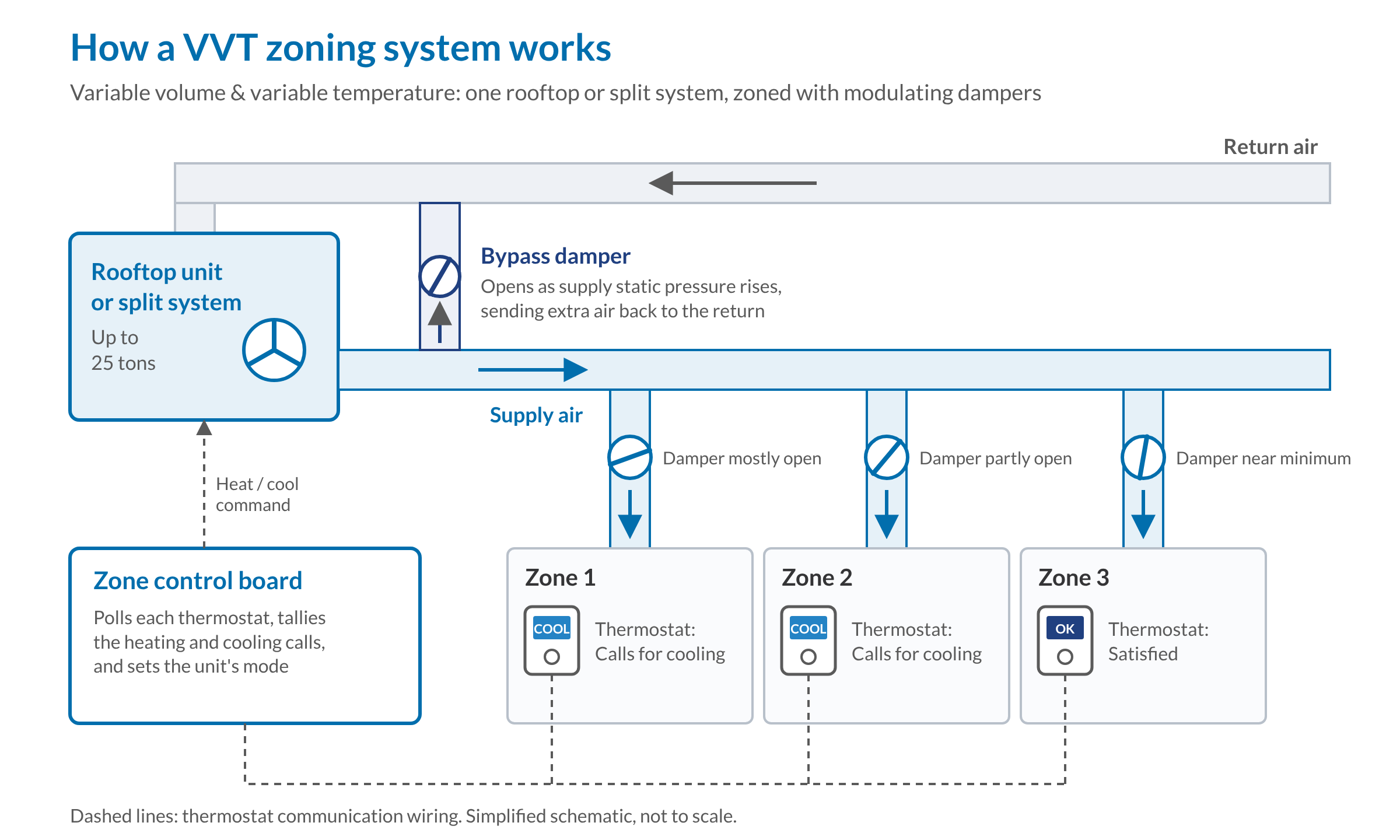
For the full sequence of operation, see our VVT system overview.
Where VVT works best
VVT is built for the jobs most mechanical contractors see every day: retail, offices, medical and dental offices, restaurants, churches, schools and other light commercial buildings served by units up to 25 tons. It is often a retrofit. It uses the existing unit and ductwork, adds dampers and controls, and gives each area its own setpoint.
VVT limitations to plan for
- One mode at a time. If most zones call for cooling, a zone that wants heat has to wait. Zone thermostats can control baseboard heat or reheat coils to cover those zones.
- Bypass air affects the coil. Air sent back through the bypass makes the return air colder in cooling and warmer in heating. Discharge air temperature limits protect the equipment. On units with multi-speed or variable-speed fans, more of the excess airflow can be handled at the fan instead of the bypass.
- Zone design matters. Group spaces with similar loads and schedules. A south-facing glass lobby and an interior server closet should not share a unit if you can avoid it.
What is a VAV system?
VAV stands for variable air volume. In a true VAV system, the supply fan changes speed to hold duct static pressure. Each zone has a VAV terminal box that varies the airflow into the space, and many boxes have reheat. VAV is usually tied into a building automation system, and it is typically found on larger buildings served by central air handlers or large rooftop units.
VVT vs. VAV: what’s the difference?
Both systems vary the airflow to each zone with a damper. The difference is what happens at the unit.
- Fan: VAV slows the supply fan as zones close. A classic VVT system uses a constant-volume fan and handles the extra air with a bypass damper.
- Supply air temperature: VAV usually supplies cool air all the time and uses reheat for zones that need heat. VVT switches the whole unit between heating and cooling based on zone demand, which is where the “variable temperature” comes from.
- Scale and cost: VAV makes sense on larger systems with many zones and a building automation system. VVT gives light commercial buildings room-by-room control without that cost or complexity.
Short version: if the job is one or more rooftop or split systems of 25 tons or less, VVT is usually the right-sized answer. If the job is a central system with dozens of zones and year-round simultaneous heating and cooling, look at VAV.
What is a VRF system?
VRF stands for variable refrigerant flow. A VRF system pipes refrigerant from one or more outdoor units to multiple indoor units, and a variable-speed compressor matches capacity to the load. Heat-recovery VRF systems can heat some spaces while cooling others. Because VRF indoor units generally don’t bring in outdoor air, most VRF projects also need a separate ventilation system.
VRF vs. VAV: which is better?
Neither one is better in every case. It depends on the building.
- Pick VRF when the building has lots of small rooms with very different loads, you need simultaneous heating and cooling, there is little room for large ducts, or the owner is moving to all-electric heat.
- Pick VAV when the building already has a central air system, the zones are open-plan, or the owner wants ventilation, heating and cooling handled through one air system run by a building automation system.
- Remember the trade-offs. VRF needs a lot of refrigerant piping, installers trained on that manufacturer’s equipment, and attention to refrigerant safety rules (ASHRAE Standard 15) in small occupied rooms. VAV needs more duct space and a more involved controls job.
On the 5–25 ton jobs where most mechanical contractors work, the real choice is usually zone the existing RTU with VVT, or replace it with VRF. If the existing equipment has life left and the loads are reasonably similar, zoning is usually faster, less disruptive and lower cost.
Can you zone a ducted VRF system?
Yes. A ducted VRF indoor unit often serves several rooms through one duct system, so those rooms share a single thermostat. That brings back the same comfort problem VRF was supposed to solve. Adding modulating dampers and zone thermostats lets one ducted indoor unit serve several zones.
Zonex’s VRF-VAV system with Smart Air Valves is built for this. It works with ducted indoor units from major VRF manufacturers. Check the product page for the current compatibility list.
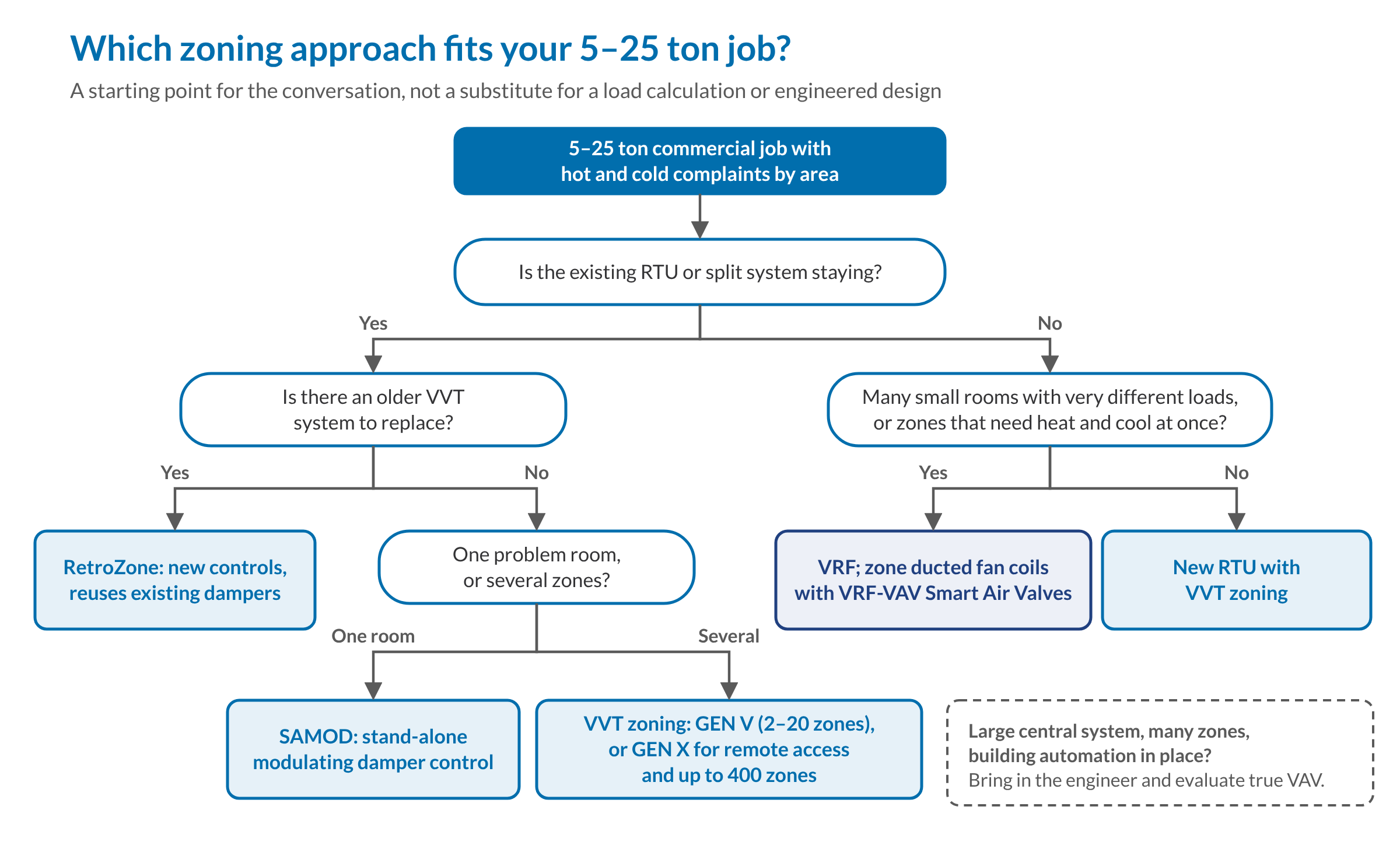
How to choose: a quick decision guide for 5–25 ton jobs
| If the job looks like this… | Start here |
|---|---|
| Existing RTU or split system with life left; hot and cold complaints in different rooms | VVT zoning, such as GEN V or GEN X |
| Multiple RTUs across one or many sites; the owner wants remote access and scheduling | VVT with networked, app-based control (GEN X) |
| Older VVT system that is failing or no longer supported | Controls upgrade that keeps the existing dampers where possible (RetroZone) |
| One over-conditioned room or sub-zone off a larger system | Stand-alone modulating damper control (SAMOD) |
| Ducted VRF indoor unit serving several rooms | VRF zoning with modulating dampers (VRF-VAV) |
| Large central system, many zones, a building automation system already in place | True VAV, with an engineer of record |
Not sure which way to go on a job?
Send us the unit tonnage, number of zones and building type. A Zonex applications engineer will review it with you and help you lay out the system.
Or call (800) 228-2966, option 2
Before you quote a VVT job: a contractor checklist
- Confirm the unit. Check the tonnage (up to 25 tons), the fan type (constant volume, multi-speed or variable speed), and the number of heating and cooling stages.
- Lay out the zones. Start from a room-by-room load calculation, such as ACCA Manual N for commercial buildings. Group rooms by exposure, use and schedule, not just by floor plan.
- Size the dampers. Size each zone damper for its zone’s design airflow and keep the face velocity reasonable so the dampers stay quiet.
- Size the bypass. On a Zonex VVT system, the bypass damper is sized for 100% of the unit’s rated CFM. Set the static pressure setpoint to match the duct design.
- Plan for the exceptions. Identify zones that may need heat while the rest of the building cools, and plan baseboard or reheat for them.
- Check ventilation. Confirm that outdoor air still meets code at minimum damper positions. Use ASHRAE Standard 62.1 or your local code.
- Get the paperwork. Pull the submittals, guide specs and CAD drawings early so the engineer and the inspector have what they need.
Why contractors zone with Zonex
Zonex Systems makes commercial and residential HVAC zoning systems and is part of Trolex Corporation. We focus on making zoning simple to quote, simple to install and simple to support:
- Application help before you bid. Our applications engineers review your job and help you lay out the system.
- Systems for the jobs you actually do. 2–20 zones per RTU or split system, wired control from one hub thermostat, app-based remote control, retrofits for older VVT systems, and zoning for ducted VRF.
- Documentation you can hand off. Product literature, submittals, wiring schematics, sequences of operation and CAD drawings.
- Tech support from people who know the product. Call (800) 228-2966, option 3, or email techsupport@zonexsystems.com.
Frequently asked questions
What does VVT stand for in HVAC?
VVT stands for variable volume and temperature. It is a zoning method for constant-volume, multi-speed or variable-speed rooftop and split systems. Modulating dampers vary the airflow to each zone, and the unit switches between heating and cooling based on what most of the zones need.
Is VVT the same as VAV?
No. Both vary the airflow to each zone, but VAV usually changes the supply fan speed and uses terminal boxes with reheat on larger central systems. VVT, also called changeover bypass VAV, zones a single rooftop or split system with dampers and a bypass, and switches the unit between heating and cooling.
What size units can use VVT zoning?
VVT is typically applied to rooftop and split systems up to 25 tons with constant-volume, multi-speed or variable-speed fans. Zonex commercial systems control 2–20 zones per unit, and GEN X can expand to as many as 400 zones across multiple units.
Can a VVT system heat and cool at the same time?
Not from the main unit. A VVT system runs the unit in one mode at a time, based on what most zones are calling for. Zones that need the opposite mode can use baseboard heat or reheat controlled by their zone thermostat.
Do you need a bypass damper with VVT?
On constant-volume units, yes. The bypass damper relieves excess supply static pressure when zone dampers close, which keeps airflow across the coil and keeps registers quiet. On a Zonex VVT system, it is sized for 100% of the unit’s rated CFM.
Is VRF better than VAV for a small commercial building?
It depends on the building. VRF fits buildings with many small rooms that have very different loads, or where simultaneous heating and cooling is needed. If the building already has rooftop units with life left, zoning them with VVT is often the faster and lower-cost way to fix comfort problems.
Have a job on your desk right now?
Tell us what you’re working with. We’ll help you choose between VVT, VRF zoning or a retrofit, and get you a quote.
